
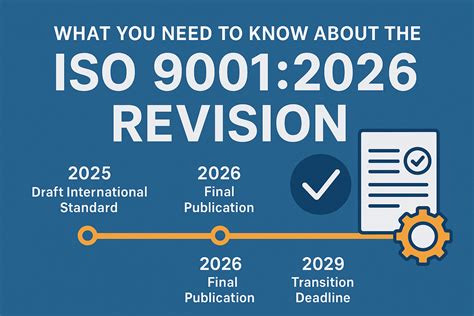
The new edition of ISO 9001 publishes on 16 September 2026. It replaces ISO 9001:2015, which has been the standard for eleven years.
If you hold ISO 9001, three things are worth knowing straight away. Your certificate is not about to stop working. You will have roughly three years to move across. And the changes are real but not dramatic.
What follows is what is actually changing, what it means for your management system in practice, and when you need to do something about it. One caveat up front: until the standard publishes in September this is based on the Draft International Standard, so wording can still shift slightly. The direction of travel is settled.
The dates that matter
Publication is 16 September 2026.
A three year transition is expected, in line with recent ISO revisions, which puts the deadline at around September 2029. Certification bodies will confirm their own timetables once the standard is out.
In practice that means your next surveillance audit will almost certainly still be against ISO 9001:2015. You are not scrambling. But if you are certified, this will land in one of your audits between now and 2029, and the organisations that handle it calmly are the ones who start looking at it in the first year rather than the last six months.
Evolution, not a rewrite
The bones are unchanged. The clause structure stays, the process approach stays, Plan Do Check Act stays, risk-based thinking stays.
If you have a working system, you are not rebuilding it. You are adding to it in specific places.
What is actually changing
Quality culture and ethical behaviour, clause 5.1.1
The most significant addition. Leadership now has an explicit requirement to promote a culture of quality and ethical behaviour.
This is the clause people will find hardest, because it is not satisfied by a procedure. An auditor cannot read a document and tick it. They will ask your staff questions and judge the answers.
It also appears in clause 7.3, awareness, so your people need to understand the organisation’s quality culture and ethical expectations, not just their own tasks.
Risks and opportunities get separated, clause 6.1
Clause 6.1 splits. Risks and opportunities have been treated as one lump since 2015, and most organisations responded by writing a risk register and quietly ignoring the opportunities half.
The revision creates separate requirements: 6.1.2 for actions to address risks, and 6.1.3 for actions to address opportunities.
If your current risk register has forty risks and no opportunities, that is the gap, and it is the one we expect to generate the most findings.
Strategic direction, clause 5.2.1
Your quality policy and objectives now have to line up with the long-term direction of the business.
The intent is to stop the quality system running as a parallel universe that exists for the auditor. If your quality objectives have nothing to do with what the board is actually trying to achieve this year, that will start showing up as a finding.
Change management, strengthened
Requirements around managing change are tightened, covering planning, communication, monitoring and review of changes to the system.
Climate change, clause 4
Content from Amendment 1:2024 is folded into clause 4.
Worth pausing on this one. That amendment already applies to ISO 9001:2015. It was published in February 2024 and took effect immediately, requiring you to consider whether climate change is a relevant issue in your context, and to account for the expectations of interested parties on it.
A lot of certified businesses missed it. If you have not addressed climate change in your context analysis, you are not waiting for 2026, you are already behind. It is a small piece of work and worth doing now.
Annex A rewritten
The informative Annex has been substantially revised to explain the structure, terminology and intent behind the requirements. It adds no obligations, but it is genuinely useful if you have ever argued with an auditor about what a clause means.
A limited set of core terms from ISO 9000 also move into the standard itself, so you need fewer documents open to read it.
What this means for your system in practice
For most organisations with a functioning system, the work is:
- Add opportunities properly, as a separate exercise from risks, with owners and actions
- Update your context analysis to cover climate change, if you have not already
- Connect your quality objectives to the actual business plan rather than to last year’s objectives
- Work out how you evidence quality culture and ethical behaviour, because it is now auditable
- Review how you plan and communicate changes to the system
- Refresh awareness training to cover culture and ethics
None of that is a rebuild. It is a handful of targeted updates, and the earlier you do them the more likely they are to be genuinely embedded rather than assembled the week before an audit.
The one that takes longest is culture. You cannot write it in a fortnight, because an auditor will test it by talking to your people.
When you will actually be audited against it
Certification bodies will publish transition plans after September. Broadly, expect them to start auditing against the new edition once their own auditors are trained, and to want you transitioned well before the 2029 deadline rather than on it.
If your re-certification audit falls in 2027 or 2028, that is realistically your transition point. Work backwards from that date rather than from 2029, because certification bodies get very busy at the end of a transition window and you do not want to be booking an audit in the last quarter.
What we would do now
Nothing urgent, but three things are worth doing in the next few months.
Read the changes and work out which apply to you, particularly opportunities and climate change.
Do a gap check against the new requirements, so you know the size of the job rather than guessing at it.
Fold the changes into your next management review and internal audit cycle rather than treating them as a separate project. Systems that absorb changes through their normal cycle transition without drama. Systems that treat it as a one-off project tend to do it twice.
If you would rather someone else handled it
We take UK businesses through ISO transitions as part of the ongoing support we provide, and through full implementation for organisations coming to ISO 9001 for the first time.
If you are certifying for the first time between now and September 2029, there is a decision worth having a conversation about, whether to build to the 2015 edition and transition later, or build with the 2026 requirements in mind from the start. In most cases the second is less work overall.
Get in touch and we will tell you where you stand against the new requirements. If you are weighing up the cost of the whole thing, our guide to what ISO certification actually costs breaks the numbers down, and if you want the wider picture on standards we work with, that is on our ISO standards page.

